
10 Signs Your Child Needs a Tutor: A Parent's Guide to 1-on-1 Online Tutoring (2026)
Falling grades aren't always the first sign. Here are the 10 quiet signals every parent should watch for — plus how to choose a 1-on-1 online tutor that actually works.
Key takeaways
- Falling grades are a late signal — emotional signs (anxiety, avoiding homework, low confidence) usually appear first.
- Peer-reviewed research shows 1-on-1 tutoring can move a student up to 2 standard deviations (Bloom's 2-Sigma) — roughly two letter grades.
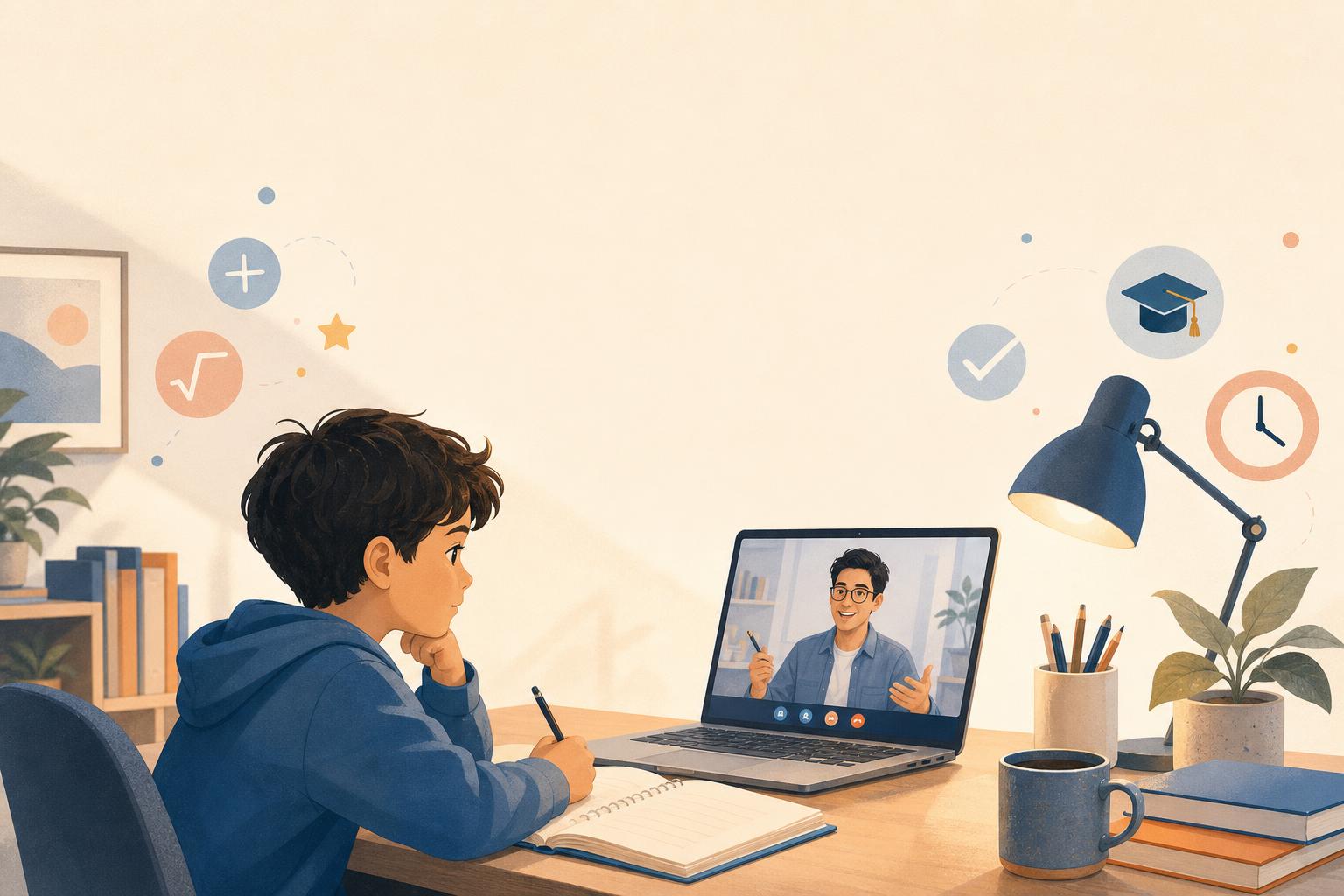
- Online 1-on-1 tutoring is as effective as in-person for most subjects, with the bonus of flexible scheduling and access to specialist tutors worldwide.
- A good tutor isn't the one with the most degrees — it's the one your child actually looks forward to meeting.
- Two trial sessions are enough to tell whether a tutor is the right fit. Never commit long-term without one.
Every parent has had that moment. The school report lands. The maths grade has slipped — again. Your child shrugs, says "it's fine," and disappears into their room. And you're left wondering: is this just a phase, or do we need real help?
You're not alone. According to the OECD's PISA 2022 report, more than 30% of 15-year-olds worldwide do not reach baseline proficiency in mathematics — and post-pandemic, that gap is widening. Demand for private tutoring has surged, with the global private tutoring market projected to reach $201.8 billion by 2026 (Global Industry Analysts).
But hiring a tutor is a big decision. This guide walks you through the 10 clearest signs your child actually needs a tutor, what research says about whether tutoring works, and how to choose the right 1-on-1 online tutor without wasting money on the wrong fit.
Why this matters: the cost of waiting
Most parents wait too long. Academic gaps compound — a child who doesn't master fractions in Year 5 will struggle with algebra in Year 8, and trigonometry by Year 10. By the time the report card screams, you're often looking at 12–18 months of catch-up work.
The compounding effect
A 2023 study published in Educational Psychology Review found that students who received targeted 1-on-1 support within 6 weeks of falling behind caught up 4× faster than students whose parents waited a full term.
The 10 signs your child needs a tutor
Watch for these signals — most parents notice 2 or 3 before realising they're connected.
1. Homework time has become a battleground
It used to take 30 minutes. Now it takes two hours, three meltdowns, and a glass of wine for you. Resistance to homework is rarely about laziness — it's almost always about not understanding the material and feeling embarrassed to admit it.
2. Grades have slipped — even just a little
A drop from an A to a B doesn't sound alarming. But teachers will tell you: the slide from confident-A to shaky-B is where intervention is cheapest and most effective. Waiting for the C to appear means you're now working uphill.
3. Your child says "I'm just not a maths person" (or science, or English)
This is the single most dangerous sentence a child can say. It's a fixed mindset signal — the belief that ability is innate and unchangeable. Carol Dweck's decades of research at Stanford show this belief alone predicts academic decline more reliably than IQ.
4. They can't explain what they learned today
Ask "what did you do in maths today?" If the answer is consistently "I dunno" or "stuff," the lesson didn't land. Repetition without understanding is the fastest route to falling behind.
5. Homework is technically "done" — but always wrong
Completed homework with consistent errors is a louder warning than incomplete homework. It means your child is practicing the wrong method and reinforcing misunderstandings every single night.
6. School feedback is shifting tone
"Could try harder." "Easily distracted." "Doesn't participate." Teachers are gentle people — when comments turn cautionary, the situation is usually further along than the words suggest.
7. Confidence has visibly dropped
Your once-chatty child has stopped volunteering in class. They no longer share what they're learning at the dinner table. They may say things like "I'm stupid" or "everyone is smarter than me." This is academic shame, and it accelerates fast.
8. They're hiding their report card or test results
Avoidance behaviour around school work — hiding tests, not showing the parent portal login, "forgetting" parent-teacher evenings — is a sign that your child knows something is wrong and doesn't know how to ask for help.
9. A new subject, teacher, or curriculum has thrown them off
Moving schools, switching from IGCSE to A-Level, jumping to a new syllabus (Cambridge, Edexcel, IB, local boards) — these transitions create knowledge gaps even for strong students. A short tutoring sprint here can prevent a full year of struggle.
10. They're bored — because they're ahead
Yes, this is also a sign. A bright, under-challenged student loses motivation just as quickly as a struggling one. The right tutor accelerates, enriches, and prevents the disengagement that turns a brilliant 10-year-old into an apathetic 14-year-old.
How many signs did you notice?
1–2 signs: Watch closely for 2–3 weeks before acting. 3–5 signs: Book a free trial tutoring session this month. 6+ signs: Don't wait. The longer the gap, the harder the catch-up.
Does tutoring actually work? What the research says
Yes — and the evidence is older and stronger than most parents realise.
In 1984, educational psychologist Benjamin Bloom published the now-famous 2-Sigma Problem. His finding: students who received 1-on-1 tutoring performed two standard deviations better than students in conventional classrooms. In plain English: the average tutored student outperformed 98% of classroom-only students.
More recent meta-analyses confirm it:
How 1-on-1 stacks up against other interventions
Relative effect sizes normalized against 1-on-1 tutoring, based on Education Endowment Foundation 2024 Teaching & Learning Toolkit.
Is online tutoring as good as in-person?
This is the question every parent asks — and the answer surprises most of them.
A 2022 meta-analysis in the Review of Educational Research examined 105 studies and found no statistically significant difference in learning outcomes between in-person and high-quality online 1-on-1 tutoring. In some subjects (coding, languages, advanced maths), online was better — because parents could access specialist tutors who simply didn't exist in their city.
What makes online tutoring work — or fail
It works when:
- Sessions are 1-on-1 (not 1-to-many webinars)
- There's a real-time shared whiteboard
- The tutor is trained for online delivery, not just transplanting a classroom
- Parents get progress updates (not just "session done")
It fails when:
- The platform is glitchy or hard for a child to use independently
- The tutor reads from slides instead of responding to the child
- There's no homework feedback loop between sessions
How to choose a 1-on-1 online tutor
Most parents pick the wrong tutor on the first try. For a detailed 10-point checklist covering trial lessons, red flags, and fair pricing, see our guide on how to choose an online tutor in 2026. Here's the short version:
| What to look for | Why it matters | Red flag |
|---|---|---|
| Free trial session | You can't tell from a profile if your child will connect | "No trials, pay upfront for 10 sessions" |
| Subject specialism, not generalist | A specialist Maths tutor beats a generalist every time | "I teach everything from Year 1 to A-Level across 14 subjects" |
| Curriculum match (Cambridge, Edexcel, IB, local) | Syllabi differ — wrong-curriculum tutoring wastes time | Vague answers about which exam board they prepare for |
| Progress reporting to parents | You need to see what's improving | Silence between sessions |
| Tutor uses your child's name and adapts pace | Engagement is the #1 predictor of outcomes | Generic, scripted lessons |
| Reasonable session length (45–60 min) | Longer sessions don't help children focus | 90-minute "marathon" sessions |
| Recorded sessions or notes | Your child can review later | Nothing to refer back to |
The two-trial rule
Never commit to a long-term package after a single trial. Book trials with two different tutors before deciding. The contrast tells you instantly which style suits your child.
How much should 1-on-1 online tutoring cost?
Pricing varies wildly by country and subject. Here's a rough global guide for 2026:
| Region | Primary level (per hour) | Secondary level (per hour) | Advanced / Exam prep (per hour) |
|---|---|---|---|
| UK | £20 – £40 | £30 – £55 | £45 – £80 |
| USA | $25 – $50 | $40 – $70 | $60 – $100 |
| UAE / Gulf | AED 80 – 180 | AED 120 – 250 | AED 200 – 400 |
| Australia | A$35 – A$60 | A$50 – A$85 | A$70 – A$120 |
| South Asia / SE Asia | $8 – $20 | $12 – $30 | $20 – $50 |
A note on price vs value
Cheaper is not always worse — and pricier is definitely not always better. The best predictor of value is engagement and progress, not hourly rate. A $15/hour tutor your child loves will outperform a $80/hour tutor they dread.
When NOT to hire a tutor
Tutoring isn't always the right answer. Skip it (for now) if:
- Your child is physically unwell or sleep-deprived — fix that first
- The struggle is one bad term with one bad teacher — wait one more term
- There's an undiagnosed learning difference (dyslexia, ADHD, dyscalculia) — get an assessment first; the right tutor must understand the diagnosis
- Your child is resisting all extra work as a sign of burnout — they need rest, not more lessons
Frequently asked questions
Your next step
If you've noticed even three of the signs above, the cheapest, lowest-risk thing you can do is book a free trial session. No commitment, no upfront payment — just 30–45 minutes to see how your child responds.
Try a free 1-on-1 trial with a certified tutor
Afla Guide matches your child with a specialist tutor for their exact subject, curriculum, and learning style — anywhere in the world. Book a free trial today and see the difference in one session.
Book Your Free Trial on WhatsAppSources: OECD PISA 2022 Report · Benjamin Bloom, "The 2 Sigma Problem", Educational Researcher (1984) · Education Endowment Foundation Teaching & Learning Toolkit (2024) · Global Industry Analysts Private Tutoring Market Report (2024) · Review of Educational Research, Vol 92 (2022).